


An upright piano is the heaviest single object in most homes. A small upright runs roughly 400 to 600 pounds, and a full-size one can reach 800, which puts it past what a standard furniture dolly is rated to carry, according to This Old House and HireAHelper.
That weight sits high and narrow, which is the real problem. An upright is top-heavy, so it does not tip gradually, it goes over all at once.
This guide covers how to move an upright piano the way it is actually done: what to measure first, what equipment you need, how many people it takes, and where the job stops being a DIY project. If you are in Northern Virginia, our piano movers can quote your exact house and route.
Know What You Are Actually Lifting
Weight varies more than people expect, and the number decides the rest of the plan.
| Piano type | Typical weight | People needed |
|---|---|---|
| Spinet | 200 to 300 lbs | 3 |
| Console | 300 to 450 lbs | 3 to 4 |
| Studio upright | 400 to 600 lbs | 4 |
| Full-size upright | up to 800 lbs | 4 or more |
Check the rating stamped on your dolly before you trust it. A standard furniture dolly handles roughly 400 to 600 pounds, while a heavy-duty one is rated for 800 to 1,000.
If the piano outweighs the dolly, that is the end of the DIY version. Nothing else in the process fixes an under-rated dolly.
Measure the Route Before You Touch the Piano
Measure every doorway, hallway, and staircase on the path out, and the same path on the other end.
Write down the narrowest point. A piano that clears the room door and fails at the turn into the hallway has to go back, and going back is the moment people get hurt.
Clear the whole route first: rugs, runners, coat racks, the console table by the door. Prop open every door you will pass through and check that the storm door swings wide enough.
Decide where the piano lands before it moves. Setting a 500-pound instrument down twice because the spot was wrong is a wasted lift nobody wants to repeat.
Gather the Right Equipment
The gear list is short, and substituting is where most damage happens.
Piano dolly – rated above the piano’s weight, with locking wheels.
Moving blankets – four to six, enough to cover every surface.
Ratchet or moving straps – at least two to secure the piano to the dolly.
Lifting straps – forearm or shoulder straps for the tilt and the stairs.
Packing tape – to hold blankets clear of the wheels.
Work gloves – grip matters more than strength here.
A hand truck meant for boxes is not a piano dolly. Neither is a skateboard, an appliance cart, or a sheet of cardboard, and all three turn up in emergency room stories.
Wrap and Secure the Piano
Close and lock the keyboard lid. If it does not lock, tape it shut so it cannot swing open mid-carry and catch a finger.
Cover the entire body in blankets, including the back, which is unfinished on most uprights and still scratches a doorframe. Tape the blankets to themselves rather than to the finish.
Keep the blankets clear of the wheels. A trailing corner that catches under a dolly wheel stops the piano instantly, and the piano does not stop with it.
Protect the pedals separately. They stick out at the bottom, they are the first thing to hit a doorframe, and they bend.
Get It Onto the Dolly
Position four people before anything tilts: two at the heavy bass end, two at the treble end.
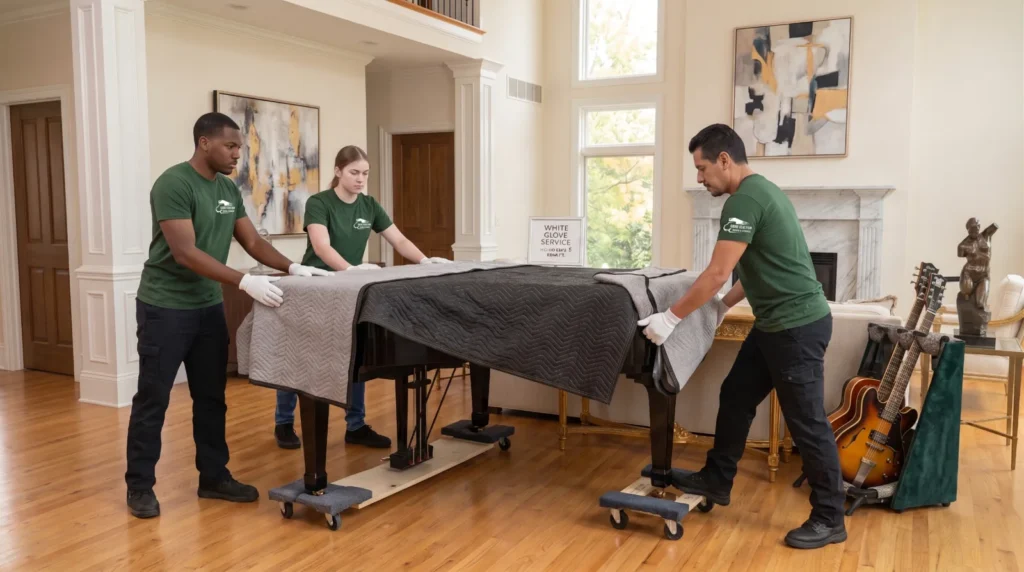
Tilt the piano only slightly, just enough to slide the dolly underneath. The instinct to tip it further is the one to resist, because an upright is top-heavy and the point of no return comes early.
Slide the dolly under the center of mass, not the middle of the piano. The bass side is heavier, so the dolly sits slightly toward it.
Lower the piano onto the dolly, lock the wheels, then strap it down with at least two ratchet straps run through the dolly frame. Push gently on the top before you go anywhere. If it rocks, unstrap and start that part again.
Stairs Are Where This Goes Wrong
Stairs are the single most dangerous part of moving an upright piano, and they are where most injuries and most damage happen.
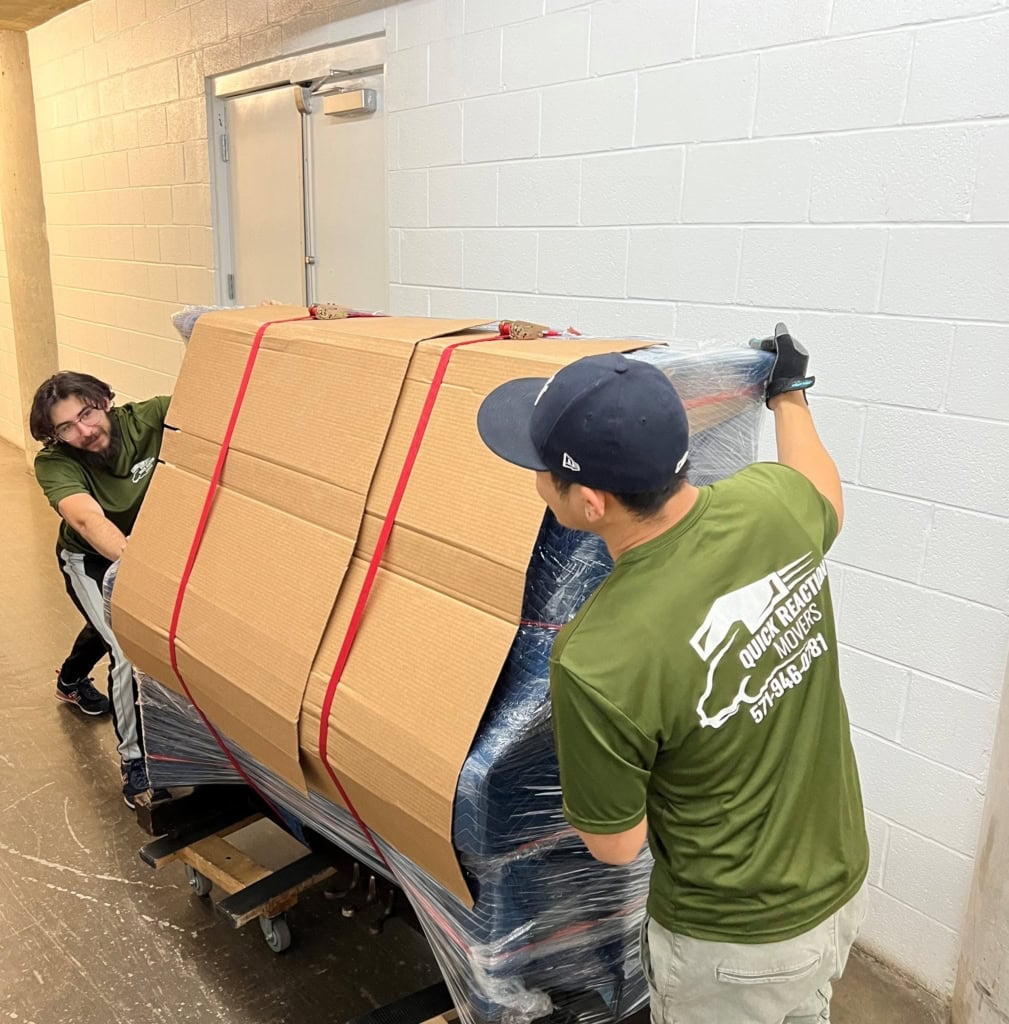
The heavy people go below the piano, always. Gravity is already on the downhill side, and the people above are steering rather than holding.
Move one step at a time with a pause between each. Nobody backs down a staircase quickly with 500 pounds in front of them, and speed is what turns a slip into an accident.
A stair-climbing dolly helps on a straight run. On a staircase that turns, with a landing in the middle, it often does not, and that is the point to call a mover rather than improvise.
Loading and Driving
Load the piano first and put it against a side wall of the truck. The wall gives the instrument support that nothing in the middle of the truck can.
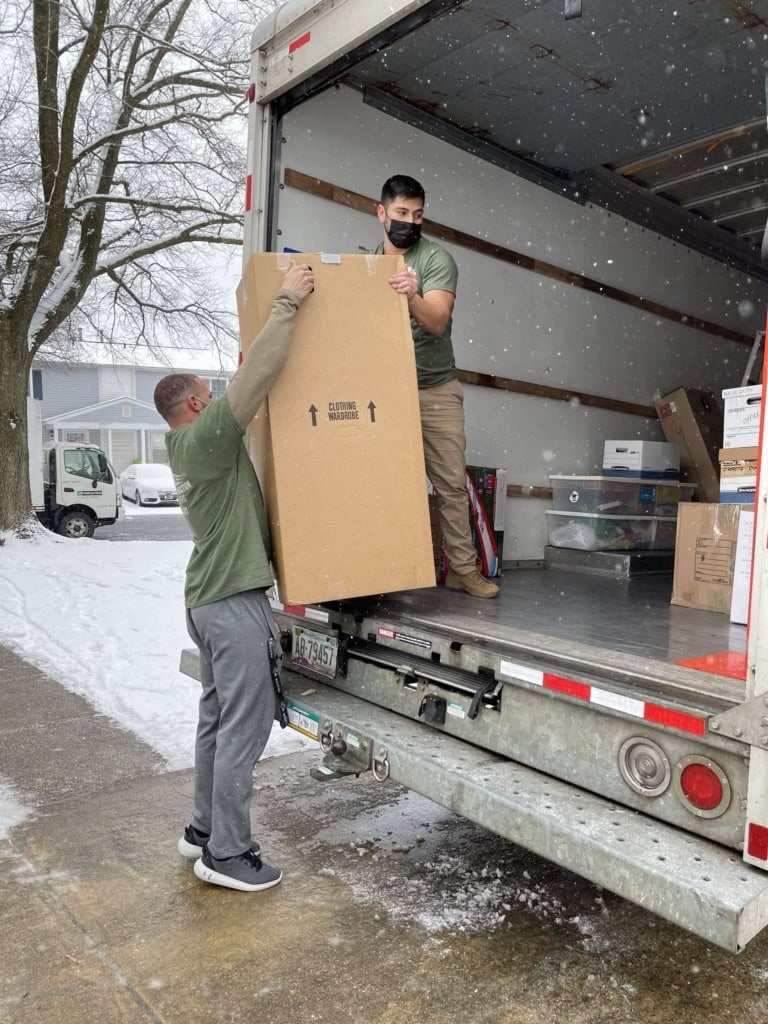
Strap it to the truck’s tie-down rails, not just to the dolly. A piano that is only secured to a dolly is a piano on wheels inside a moving vehicle.
Keep it upright. Uprights travel standing, and laying one on its back puts load on parts that were never designed to carry it.
Drive it gently and take the turns slowly. Pack boxes around the base so nothing shifts into it, and leave the blankets on until the piano is in its final position.
What Happens After the Move
Let the piano settle before you have it tuned. Give it two to four weeks in the new room so the wood adjusts to the humidity there.
Almost every piano goes out of tune in a move. That is normal and it is not damage, it is the strings responding to being carried and to a change in environment.
Place it against an interior wall where you can. Exterior walls swing further in temperature and humidity, and a piano parked beside a radiator or a vent pays for it.
If the piano is going into storage rather than straight into a room, climate control is worth the difference for exactly the same reason.
When to Stop and Call a Piano Mover
Call a mover when any of these are true: the piano outweighs your dolly, the route includes a turning staircase, you cannot get four able people, or the instrument has real sentimental or resale value.
The math is usually straightforward. Our guide to what it costs to move a piano puts a local piano move at roughly $200 to $1,000, which is well under the cost of repairing a dropped upright, a cracked soundboard, or a back injury.
We are a veteran-owned company in Lorton that moves pianos throughout Northern Virginia and the District. We are licensed, bonded, and insured, carry Certified ProMover accreditation, and hold an A+ grade at the BBB. Awkward heavy items other than pianos go to our large item movers as well.
Request a free estimate or call (571) 946-0781. Describe the instrument, what the staircases look like at both ends, and where it is going, and you will have a figure and a plan before anybody lifts anything.


